Sunday, April 1, 2012

Life On The Hard


Here we sit, at the mouth of the Panama Canal, in a marina.  And wouldn’t you know it?  There are two worlds here.  The regular dockside marina, with shore power, restaurants, and people wearing jewellery and clean clothes.  And then there is The Yard, where paint, dust, and other familiar dirty things are the order of the day.  We are repainting the antifouling on the bottom of our hull, and so here we are, on a gravel field, packed amongst other boats undergoing improvement.

Up we go!
It just doesn't look right, somehow.
Delightful things about being on land again:
  • Laundry, laundry, laundry.  Before we arrived, I hadn’t done laundry except in a bucket since January.  Enough said.
  • Power hookup.  This means we don’t have to rely on our almost-dead batteries.
  • A tiny store.  Even buying tomatoes can be exciting when you don’t have to get in the dinghy first.
Small inconveniences related to being hauled out:
  • No toilets aboard.  They run on saltwater... and we’re out of the water.  Since we can’t flush them, we can’t use them.
  • No sinks aboard.  We can’t drain our greywater tank, so no sinks.  All washing is accomplished via a garden hose hanging over the rail.
  • No fridge.  This also needs saltwater to run, so we have spent the past week trying to eat everything before it went bad.
  • The rickety ladder tied to the hull to allow ascent and descent.  We have drilled the girls in proper ladder technique, ie. control your monkey impulses.  So far, so good.
  • Cooking.  As I don`t have use of a sink, this is a bit of a challenge.
  • Washing the dishes on deck in a bucket.  Not my favourite job to begin with, I didn`t realize how good I had it before.

Our week has been filled with fun tasks like watching Erik attempt to electrocute himself while grinding in the pouring rain (this is the dry season, apparently) and slathering the kids with DEET to keep the nighttime hordes of mosquitoes at bay.  But we have gotten past sanding tiny spots of aluminum and actually put zinc chromate primer on the hull today.  And that may not sound exciting (or comprehensible) to you, but I am dancing a jig, here.  That means that actual barnacle-killing paint is not far behind, and we can get ourselves back into the water.  Because sleeping on a boat that doesn`t move just feels weird.  (And when it does move, it feels terrifying.)

Your correspondent remains a woman of glamour and mystery, even wearing lab gloves, a face mask and that hat.  In the rain.
What do you mean this doesn’t look like paradise?  There are palm trees in the background, aren’t there?
As an extra bit of excitement, the local firemen kicked us off the boat briefly this afternoon.  Because they were spraying a colony of Africanized killer bees in the bushes 50 feet away.  And that may sound bad enough, but two days ago, while the girls and I were out, Erik chased a swarm of over a hundred enormous bees out of our boat armed only with a can of roach spray.  The last bees were leaving as we arrived home, and they were each the size of my thumb.  Were they really killer bees?  They certainly looked scary enough.  But they didn't kill Erik, so maybe they were some of those so-called domesticated Africanized killer bees.  I think I`ll still leave the antihistamines where I can find them easily.

The man in the bee suit pouring poison in a bucket isn’t really what you want to see next door.
What will the next week “on the hard” bring?  Well, we still need to weld that leak in the aft fuel tank and wrestle the centerboards back in, so don’t worry about us.  Excitement abounds!

Saturday, March 24, 2012

Con-ga! or, Top O' The Mornin'!


Last Saturday was St Patrick’s Day.  And what do we all think of on St Patrick’s Day?


Why, the Portobello Conga festival, of course!  And my apologies to the Irish among you, but it beat the heck out of drinking green beer.


Sorry, Seamus.  You just can't compete.


 The whole town was dressed up.


Squee!  Cuteness overload!
Busloads of conga troupes arrived.

No, they didn't paint that bus for the festival...
The buses always look like that.
As at any good outdoor party, street-meat was the order of the day.

Mnohm nohm nohm.
The party began with a boat tour around the harbour.

Then the troupes danced their way from the dock to the town square.


(And if you can’t appreciate the delicious illumination of human nature as illustrated by a woman flipping off her friend while marching in a parade, I just don’t want to know you.)

Even the cops couldn’t resist taking pictures.
Even the police need to get their conga on.
Sure, everyone got a little distracted now and again.

We interrupt this parade for an urgent text message.

Can’t.  Sit.  Still!
But they all pulled it together.  Each troupe got to strut their stuff on stage, and they were fantastic.


I wish we knew more about the symbolism of their outfits; the fertility symbols were pretty easy to figure out, but the dolls hanging from everyone’s clothing made me curious.  There were also a couple of men dressed as construction workers - orange pinnies, hard hats – and that really has me stumped, since the rest of the men onstage appeared to be kings or devils.  Where does the dressed-for-safety builder fit into this mythology?  On a similar note, I saw one of the off-duty kings step on part of a broken bottle.  He stopped, reached into his decorated bag, and pulled out a large black telephone receiver which he used to knock the offending glass off his Croc.  And while I applaud this creative repurposing of a now-useless device, I ask you: do you carry old-timey phone parts in your purse?  Because I don’t.  These fashion trends are passing me by.
Used as the manufacturer intended.
Eventually the rain came, and it was time to go home, happy and full.
When even the queens are hiding under superhero blankets, the party’s over.
Best.  St Patrick’s.  Ever.

Tuesday, March 20, 2012

Sewing and other occupations

This week has been a series of dizzying highs and terrifying lows for Papillon as we float here in Portobello and the howler monkeys bellow through the hills.  The good: Stylish writing notes to the family in Cuneiform.  I asked Stylish to tell Erik what we had been talking about in school that day, and Indy burst out: “Hammurabi!  Babylon!”  The bad: I came within a hair’s breadth of permanently breaking the generator.  (Who knew that water + diesel engines = apocalypse?  I guess I kind of forgot.  I have been sentenced to learn and internalize the diesel engine chapter of Calder’s Boatowner’s Mechanical and Electrical Manual.  It is going to be a slog, but I suspect I got off easily.)

At least I wasn’t in front of that cannon.
But let’s take a step back in time and talk some more about the San Blas islands.  We did more than read and dig sandcastles, you know.  Oh, yes!  We also bought molas.

For those of you unfamiliar with Panama, Kuna Yala is an autonomous province east of the canal on the Caribbean side, and the San Blas are a part of it.  The Kuna Indians live there.  And while their old way of life is slowly falling away, the Kuna still make reverse appliqué fabric art pieces called molas.  This involves many layers of fabric, tight stitching, and obvious artistic flair.


These are normally worn by the ladies as a panel above the waist on the front and back of a blouse.

And, inevitably, some are sold to gringo tourists.

My mother is a quilter.  No, a Quilter.  Perhaps even a QUILTER.  In short, she sews any bit of fabric she finds that isn’t otherwise occupied, as well as some that are.  She attends a quilting camp with her buddies for two weeks every summer, learning fancy sewing stuff from other experts.  It’s like that.  So Mom had molas on the brain before she even arrived.

I knew that was coming.  What I didn’t expect was Erik’s interest.

We arrived in the San Blas about a week before my parents.  From the first day, the cayucas were padding up to our boat, and the ladies showing off their wares.  Normally, the ladies would have a five gallon pail neatly filled with molas.  We would invite them aboard, they would show us their stuff, we would get excited about a piece or two, buy them, and everyone left happy.

Except this was happening every day.  By the third round, the cayuca arrived, and I said to Erik, “No, we have enough.  No thank you.”  “Okay,” he nodded, then invited the ladies aboard and bought a mola anyway.  Ugh.

It only got worse when mom arrived.  Some of the master mola-makers came out of the woodwork, and who were we to decline the chance to see their wares?  And some of their traditional pieces were truly beautiful.

By the end of my parents’ visit, we were all getting strict with each other.  “No more molas.  No really, no more.”  Then we went for dinner with a family on Miriadiadup.  And while some people were focused on the right things, like making friends and seeing birds...

Priorities straight.
...some of us looked at molas.

Hey, look!  Molas!


By the time my parents departed, we had accumulated a dizzying number of pieces.  Sure, some were gifts, but most of them were just too pretty to pass up.  If you ever visit the future Casa Schaefer and find a room covered in fabric, that’s why.

This was our combined total.  And I wish I could say they are almost all Mom’s, but a lot are ours, too.

I know, I know.


My parents went home with all of the molas, so they don’t rot on board.  Phew!  Mola-free.  We got ready to check out of the San Blas, when master mola maker Lisa knocked on our hull.

And...

Two more molas.


How could I refuse?

Saturday, March 10, 2012

What We Do On Holiday

So.  What did we handsome devils do during our vacation in the San Blas?
A fine-looking group.
We tried to keep Papillon off the reefs...

Saw turtles and fish...


Played on the beach...


Bought food out of passing lanchas...

Loafed in the hammock...

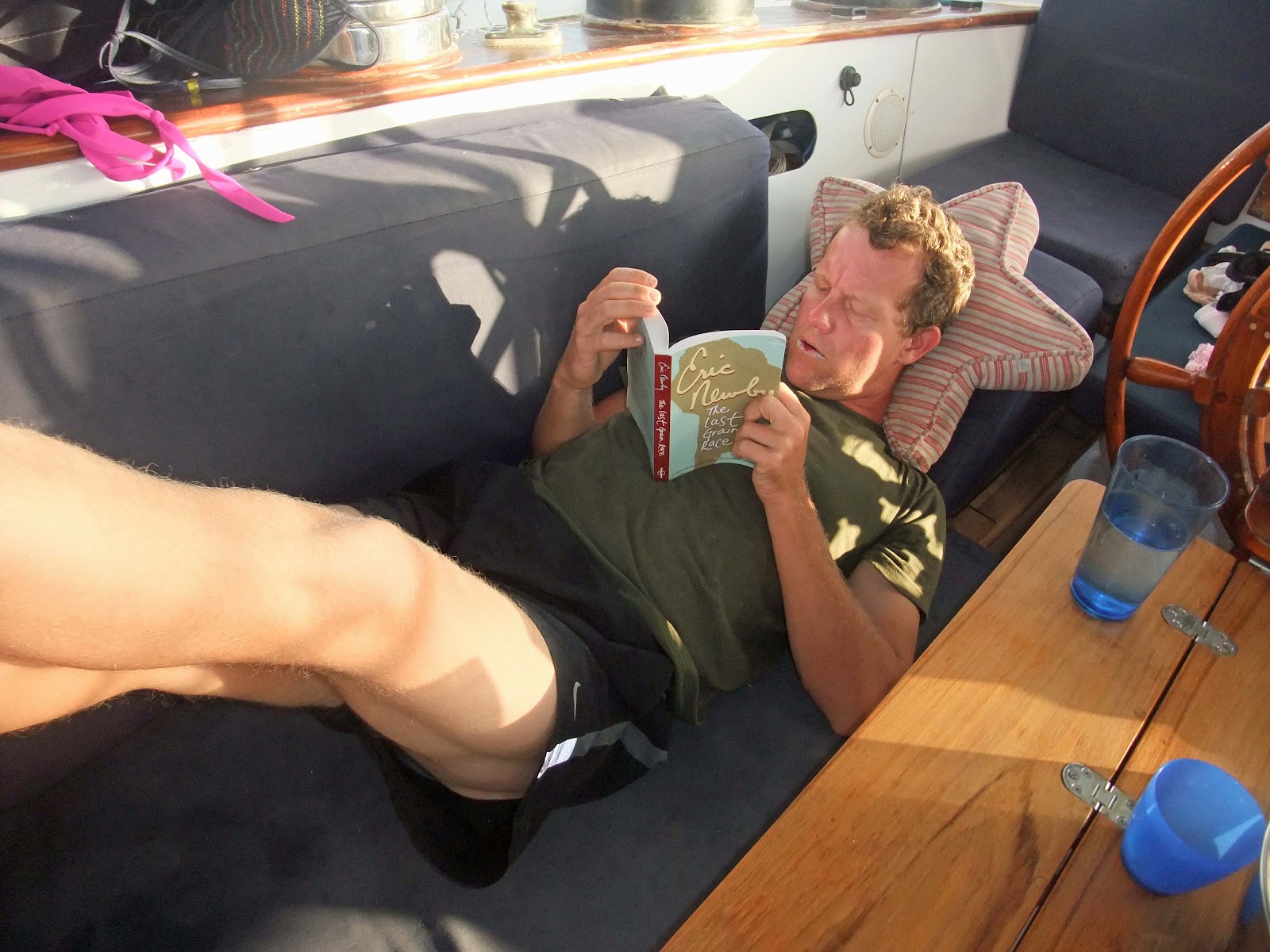
And read and read and read.


Tuesday, March 6, 2012

Bread, Glorious Bread

Continued apologies for my infrequent posts. My parents were visiting, we still don't have internet... it's the same old story. It has been a busy day, what with setting up the awning and putting out the spinnaker pole for the girls so they can swing into the water. Whew! I'm bushed.

We have moved closer to the Panama Canal, awaiting our appointment to haul the boat out and repaint the antifouling on the bottom of the hull. This means we have left the palm trees and sandy beaches of Kuna Yala behind. It also means that we can restock on supplies. This is important because we haven't bought food except from local fishermen since we left Cartagena a month ago. And my parents gave us a breadmaker.

Ta da!

Back home, we were bread eaters. Toast for breakfast, a sandwich for lunch. I liked a certain brand of fancy multigrain. Erik and the girls liked proper German graubrot. The stuff we bought was bakery-fresh, and worth every cent. Alas, as with all things, availability and quality have been less than consistent as we pressed south. Sometimes we got lucky and found an awesome baker (mmm, Guatemala). Sometimes we were stuck with the local Wonderbread equivalent (country withheld). But wherever we went, two-thirds of our freezer space went to bread storage, insurance against dark days we knew were to come.

Over time, I learned to make my own bread (occasionally) and pizza dough (more often). We made cookies and bread balls and pancakes, and generally compensated for our uncertain bread supply. So, when my parents offered us a breadmaker, I was delighted. Fresh bread! More freezer space for meat and other perishables! When I did my month-long provisioning run before we left Colombia, I decided to be conservative and buy extra flour in anticipation of the new machine. We had four pounds of flour on hand, and I bought another thirteen. Seventeen pounds of flour - it seemed ridiculously generous. It was going to turn into a weevil hotel before we could ever use it all up.

Loaf 1.0
 When the machine arrived, we were like kids at Christmas. Make cinnamon raisin bread! Olive bread! Try the Firm setting! Bake a chocolate cake! Make pizza dough! And we did. We ran through that recipe book like we'd never eaten starch before, cooking two and sometimes three loaves of delicious bread each day. We set the timer to have it ready just before breakfast, and usually had the machine refilled for a second run before the elements had cooled. We gorged. Our bellies became - pardon the expression - doughier. And my flour stocks dwindled.

My parents had only been with us for a week when I realized we were going to run out of flour. I calculated that we had enough flour for one loaf per day until they left - no more. No more cakes. No more oven-fresh thick slices. The rationing began.

We barely made it through the week. Erik miraculously found a further four pounds of flour in Carti when he dropped my parents off. Hooray! But still, two passengers lighter, we were still careful with our bread. Who knew when we would find flour again?

We sailed to Portobello, rejoining the world of towns and stores. We stopped into a mini-super (a term I love), aka a store the size of my old living room. And they had flour. And I bought seven pounds. That should last the week, shouldn't it? Hooray for bread! Flabby tummies, be damned!

Saturday, February 25, 2012

Dangers in Paradise

My parents are just wrapping up their two-week holiday with us here in the San Blas (boo). We have had a wonderful time eating lobster, reading, buying molas, reading, swimming and reading.

But even here amongst the palm trees and gentle waves, dangers abound. Here is a list of injuries sustained aboard Papillon during their visit. (Names are withheld to protect the clumsy. Although you may be surprised which injury applies to whom.)

-Slice along shin. (Occurred while climbing over a fabric-covered lifeline. How one generates a cut, not a cloth-burn from such an activity remains a mystery.)
-Bruised/strained thumb. (Injury extended from top to base of thumb. Sustained by slipping off the motor while climbing into the dinghy.)
-Toe stubs. (Many and as expected)
-Metal shavings in feet. (Remnants of work on the boom, despite weeks of shop-vac-ing. Bare feet make the best vacuum cleaners.)
-Knot on top of head. (Sustained jumping off the companionway and hitting head on ceiling.)
-Portugese Man-o'-war sting. (Luckily, this nasty jellyfish was only the size of my top thumb joint, or we would have been in trouble. Ammonia helped the sting, and the welt was gone in a few days.)
-Pin in finger. (Sewing-related injury. Lots of blood.)
-Bruised elbow. (Tripped over shop-vac.)
-Sunburns. (As expected. Many and varied.)
-Inner thigh bruise. (Skin caught in Ascender while going up the mast. Could have been ugly, but the skin was quickly pulled out by a helpful, spouse, and not too much was pinched.)
-Thumb flattening. (3 lb sledgehammer to the thumb. Twice.)
-Forearm bruise. (A winch flew apart, mildly injuring the person turning the winch and smashing a portlight. The captain may have been heard to mutter he'd rather the arm had broken.)
-Leg bruise. (Bumped into a rounded bench.)
-Bite. (Something akin to a deerfly. Large painful welt on back of the knee.)
-Forehead bruise. (Sustained by not properly securing the fridge lid, then leaning inside for something. Smack - down came the lid.)

So beware, friends. We may not be slipping on the ice, but even here, danger lurks at every turn! Also, delicious fish and sandy beaches.

----------
radio email processed by SailMail
for information see: http://www.sailmail.com

Thursday, February 16, 2012

What Have You Been Missing?

Here we are, on another fine day in the San Blas islands. My parents have arrived, and we are spending quality time doing what our family always does on vacation: reading. Oh, sure, we also go swimming and eat too much, but it isn't long before two-thirds of us have a book in hand and are flaked out in the hammock or on deck. Just the way a holiday should be.

And, while we are having this relaxing time away from fixing toilets and sewing sail covers, what am I not writing about?

Amy's Rejected Blog Topics

1. We Are Slow. But you've figured that out already, haven't you? For example, the other day it took us all afternoon to fill the water tanks. That was the only thing we accomplished that day - figuring out where to get drinking water, sailing there, talking to the guys on the dock, waiting for the boat ahead of us to finish, moving the boat, filling, touring the little island, deciding it was too late to move on and putting down the anchor again. Everything on a boat takes a long, long time.

2. Concealed Injuries. Last year I broke my finger, and I never heard the end of it. Stylish and her two sets of stitches also generated a lot of mail. So when, months ago, Stylish gotten bitten by a dog, I didn't say anything. She is FINE! The wound is totally healed, and the tiny scar has been given the Grandparent Seal Of Approval. Ditto when, mid-scuffle, Indy hit Stylish on the head with a rubber mallet and Stylish kicked Indy in the face. I have photos of the two of them lying on the bunks in the salon, each with a glum expression and a bag of ice. You see? You're worried, now. These are stories that cause needless stress.

3. Hey, Something Broke! Well, you actually get subjected to this story a lot. But you would be astonished at the volume of repairs and adjustments you are not privy to. So very many smelly trips into the bilge. But I try to keep to the more interesting stories.

4. And Then We Went Here, And Then We Went There... This is not a travelogue. I'll only talk about where we are and what we're doing if I have a good reason.

And that's what you haven't been missing. Since this is my vacation, too, I'm going back to my book.

----------
radio email processed by SailMail
for information see: http://www.sailmail.com

Saturday, February 4, 2012

How to Fix A Plug In Twenty Easy Steps


As you may remember from days gone by, technology doesn’t really like sailing.  Our sewing machine, an industrial Bernina my mom helped pick out, was an early victim of our difficult conditions.  We eventually bought a new machine designed for marine use, and puzzled over what to do with the Bernina.  We hit on the clever plan of fixing it and giving it to our Colombian friends.  More locker space for us, a sewing machine for them.  Perfect.

We (read: I) didn’t get around to going to the sewing machine shop.  It was far away, I wasn’t really sure where it was, I had no idea how to explain a broken presser foot in Spanish... I had many excuses.  We had time.  But suddenly our departure came over the horizon and, excuses or not, the thing had to be fixed.  Crumbs.  So we enlisted the help of the local expat technology connection.  Two weeks, one car accident (his) and a lot of phone calls (read: hails on the VHF radio), we still didn’t have the machine back.  So I trooped over to his workshop, reclaimed the machine and prevailed on the man to find a colleague who could turn the machine around quickly.  After all, it was only the presser foot that was broken... it should be easy to fix, right?  In this manner, last Sunday I made my way across town to hand over the Bernina to el mago de la tecnología.

There are days when I am heartily sorry that I don’t have a spy camera, and Sunday was one of them.

El Mago greeted me kindly when I arrived.  I picked my way down a narrow hallway littered with electronic detritus.  Halfway along, I handed the machine to El Mago over a four-foot-high stack of boxes, shimmied around them myself and followed him into the eight-by-twelve work area.  Space had been carved out in front of the desk for two lawn chairs, but the rest of the room was filled with discarded electronics.  Fans, televisions, motherboards; all were stacked higgledy-piggeldy along the shelves and the floor.  An ancient set of huge DVD players were turned on their ends and shelved like books along the shelf by the ceiling.

El Mago gestured to the chair closest to the doorway.  I had expected to drop off the machine and return the next day, but if he was willing to do it while I waited, then I was waiting.  I sat down carefully, trying not to topple a forlorn-looking fax machine crouched directly behind me.  By my knees was an open cubby filled to overflowing with wire coils, plugs, cords and unidentifiable metal bits and bobs.  I settled in to watch the magic unfold.

Over the next three hours, I had a lesson in small appliance repair.  Rather, I had a in lesson in How to Fix Whatever Comes Your Way.  Back home, you would take your broken Bernina to your local Bernina repair shop where a Bernina master technician who studied the sewing repair arts for twenty years deep in the mountains of Switzerland would charge you the Earth to use genuine Bernina parts to fix your machine.  And somehow we think that is normal and right, and deny we have wandered over the city limits into Crazyville.  Here, instead, I had El Mago, a man clearly possessed of many years of experience with technology of all sorts.  How many Bernina hours he’d racked up I didn’t know or care.  He was reassuring somehow, like a Spanish Mr Rogers.  Maybe not as tidy, but I could see my machine was in good hands.

El Mago settled back into his chair.  He searched about his desk until he located a multimeter.  There followed a long period during which each hole and prong in the pigtailed cord was tested against each other hole and prong.  Sometimes there were happy noises, sometimes not.  El Mago thought.  He decided that he wasn’t happy with the part of the plug that connected to the presser foot.

Now.  I don’t know if you have ever tried to open up a plug.  What am I saying?  Of course I know: you haven’t.  Unless you once were an eleven-year-old with a do-it-yourself electronics kit, it has never even occurred to you that one can open a plug.  My friends, I am here to confirm it is so.

How To Repair A Plug
As witnessed by Papillon Crew
  1.  Examine the seam of the plug very carefully.
  2. Gently apply a hacksaw blade to said seam.
  3. Saw energetically.
  4. Repeat with opposite seam.
  5. Crack the seam.  Listen to the distant death throes of the Bernina Repair Guild.
  6. Examine the innards.
  7. Jam the bare ends of the cord connected to your soldering iron to a powerbar.
  8. Plug random item over the bare wires to hold them in place.
  9. Cut a wire in the plug.
  10. Strip the plug wire with an 8” machete (handle missing).
  11. Gently pin the plug under the partially-disassembled 40” flat screen TV that dominates your desk.
  12. Re-solder aforementioned wire.
  13. Test the plug with your multimeter and pronounce yourself satisfied.
  14. Send your son out for local crazy glue.
  15. Snap the plug back together.
  16. Gob local crazy glue into the seam.
  17. Apply white powdered catalyst to the local crazy glue.
  18. Allow to dry.
  19. Use a black Sharpie to cover up the hideous white scar now encircling your plug.
  20. Pat yourself on the back for a job well done.
Et, voilà!  C’est magnifique!

The plug now beeped at the appropriate times, but the presser foot still didn’t work.  Time to get to the source.  El Mago opened up the foot itself.  There followed a saga of soldering, motherboard repair and switch fiddling that would be ripe fodder for an epic poem.  I especially enjoyed the use of the soldering iron to melt off extraneous bits of an extra part El Mago had to cram into the presser foot to make it work.

Work progressed, and I continued to witness events that would give any workplace safety inspector a myocardial infarction.  More than once I was glad to have the chair nearest the door while crackling sparks flew beside me.  As the afternoon wore on, El Mago had a number of visitors.  A few stopped dead when they saw me and walked away.  Most stayed and chatted for a few minutes.  His son, a man in his twenties wearing a white rosary and a black shirt stating,  “The Demon Deacons Are Battleproof,” sat outside the front door on the concrete pad, stripping a flatscreen TV.  A junkie came by, his eyes rolling in different directions, hair at full attention, selling metal things.  El Mago bought a motherboard for a dollar.  We had a dicey moment when El Mago needed something from a shelf on the side wall, and had to climb over a few piles of TVs to reach it, but I caught the falling stack before any harm was done.  The time passed quickly.

Three hours after my arrival, the machine was fixed.  I thanked El Mago in my best Spanish for repairing the machine so quickly, and was on my way.  Tell me I would have had that interesting an afternoon in a shop with floor space and a soldering iron with an actual plug.

The sewing machine is now in the hands of our friends, and we are almost ready to set sail.  Didn’t I say that last time?  Now we are really, really almost ready.  Swimmable waters, here we come!


Google