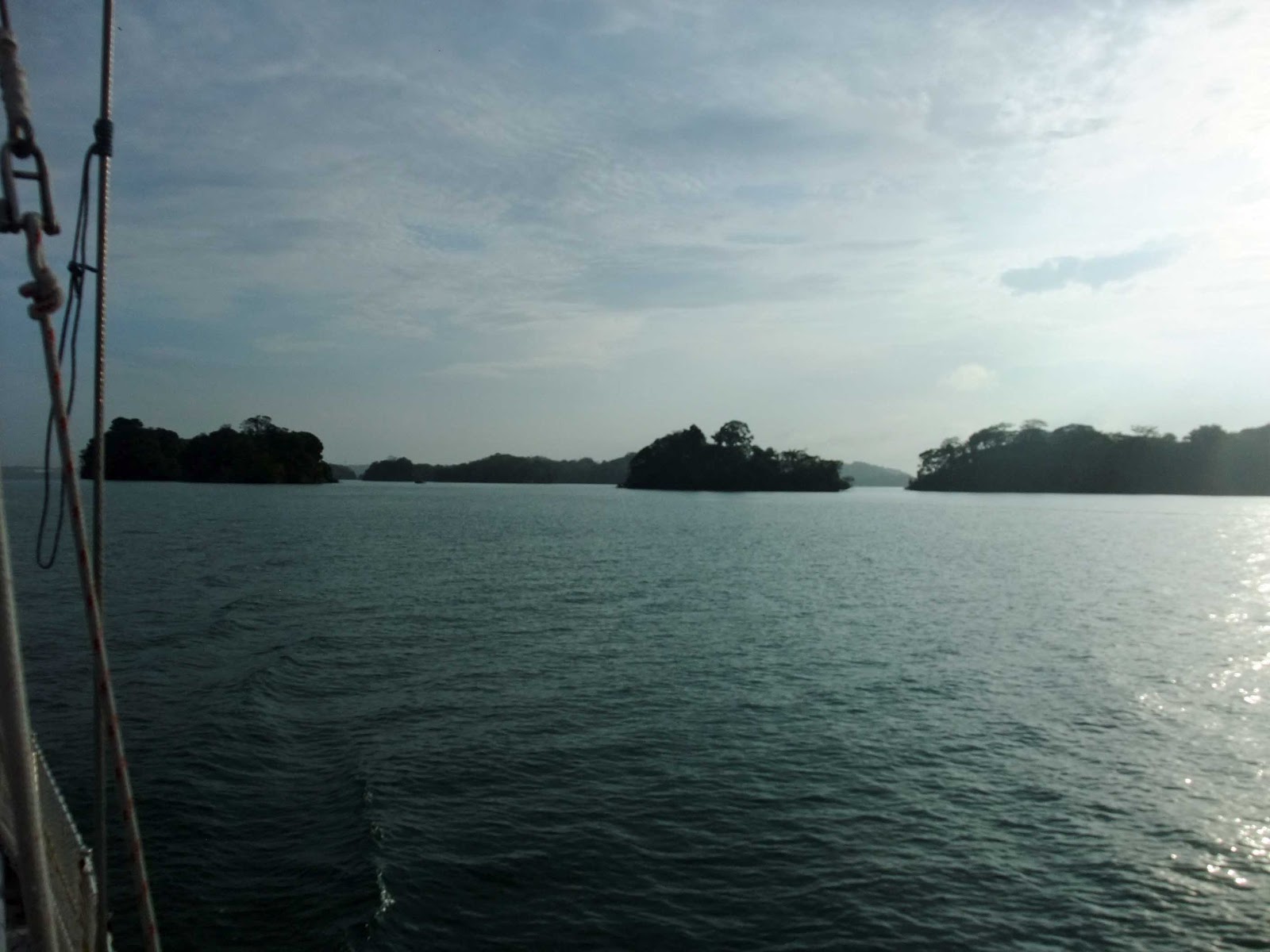
We did it! We left civilization behind! Yesterday we chugged out of Panama City and made our way to the Perlas. Here we sit, at anchor at the mouth of the Rio Calcique, the only boat in sight.
Which begs a question - where is everybody? The Caribbean was packed full of people. In some anchorages in the San Blas islands, we were jammed in with fifty or sixty boats. Cartagena and Panama City were no different. The Perlas are both beautiful - imagine a rugged, rocky landscape like Georgian Bay, with long, sandy beaches - and very close to the mainland (the northern islands are less than 40 nm from Panama City). Why isn´t this place overrun? Not that I am complaining; we have certainly earned the peace.
Some people don´t like leaving the city, and I can understand that. You never have to plan ahead in the in city; it is a fly-by-whim type of place. Oh, I forgot to buy yoghurt. I´ll walk 100 m to the convenience store. Oh, I feel like going out tonight. Should be see a movie, or hear music, or go to the theatre, or the opera, or or or... It is easy. Options galore! And when we find ourselves city-proximate, we take advantage of those things, too. We took the girls to a children´s play last week. In Cartagena, I wandered over to the grocery store almost every day to get ice and drinks for our painters. The girls and I hiked over the bridge to the (free) gold museum pretty often. It was fun.
But leaving Panama City was a different thing. That´s it for cities until November. So we had to suck the marrow out of this city before we left, and I mean that solely in terms of supplying the wagons, as it were. Every time we set foot in a store, we had to remind ourselves things like,¨"I won´t be able to buy cheese again. How much cheese can I reasonably fit in the freezer?" Erik prowled the aisles in the hardware tiendas, picking up plumbing parts and various nuts and bolts and asking himself what was going to break during the next six months, and could he fix it with what he had? It´s all about planning and forethought, and it is easy to put off departure just one more day to pick up such-and-such or more of this-and-that. And I know full well I´ll run out of some things early and be mad at myself, and other things not at all and wonder why I bought so much, but that is the way the cookie crumbles. Maybe we´ll have to live on peanut butter and tuna fish for a while. (Preferably not mixed.) I can handle it.
For us, the boat is much more fun when we can swim and explore, so we had a strong pull to finish up and get out. The girls were going mad, we are sailing late in the season in an El Niño year (which means weak winds for our Pacific crossing), so we needed to move. We wanted to move. And the appeal of just one more bag of whole wheat flour eventually wasn´t enough to keep us there. And now we´re free.
We´ll catch our breath for a few days, explore the river, then press on to the Galapagos. That will be a long passage - likely 10 days or so - with no wind, because that is how the equator rolls. But we´ll make it. And I´ll try to send these shortwave radio updates as I can.
As an administrative point, we won´t have much in the way of bandwidth for the forseeable future. Please do continue to write to us - we love it! We can´t talk to just each other forever, you know! But keep it text-only, if you please. No attachments, or our SSB-email program will ruthlessly delete your note. I know, it is tough out at sea.
----------
radio email processed by SailMail
for information see: http://www.sailmail.com
Thursday, May 31, 2012
Monday, May 21, 2012
Getting clean
With all of the
excitement of Canal transits and missing toilets and new antifouling paint and
and and, I have failed to mention a very exciting development aboard Papillon.
We bought a
washing machine!
I know! I’m dancing in a circle, too! Because what have I been complaining about
since the Earth began cooling? Yes, the
very smelly state of our wardrobe.
Having to haul bags of said stinkage to shore, wash them in machines of
dubious quality, dry them (if we´re lucky), and try to get everything back
aboard in a still-clean-and-dry state.
It was a thorn in my side.
But laundry needs
water. And, funny enough, water is in
short supply on a boat. So, no washing machine.
Enter our days on
the hard.
Cruisers love to
sell things to other cruisers. Life is a
perpetual garage sale out here on the water.
Everywhere we go, we participate the local morning VHF net. It lets people share information, contact
each other – all of those regular things we all do every day. And everywhere we have been, there is a
category called, “Treasures of the Bilge.”
Sometimes people hawk their old Corningware for weeks on end. Sometimes they offer up a 12 volt windlass
(to raise the anchor), and it is gone within milliseconds. We got rid of our surplus blueboard from the
fridge project in this fashion. It is a
good system if you don´t abuse it. By
which I mean, if you can keep your spouse from going bananas.
The marina
version of this is the bulletin board.
And boy, did Erik love walking by that bulletin board. “Amy, I bought a new outboard! It has a service manual and a full set of
spares!”, “Amy! Our neighbor has these
great solar panels!” and one day, “Amy, there is an awesome watermaker posted! We´ll sell our old one – it will be
practically free!”
I opened my mouth
to say, “Our watermaker is fine. Low
volume, but fine. We don´t need a new
one.” But Erik continued: “It does 17
gallons per hour. We could buy a washing
machine.”
The words died in my throat. A few weeks before, we had witnessed the laundry bliss of friends from Quebec, who had squeezed a cheapo machine into a locker. For $150, they had clean sheets. Clean. SHEETS. Whenever they wanted! I coveted that flimsy plastic thing.
So instead I
agreed. And Erik bought the
watermaker. And we sold ours. And we began the drama of getting new reverse
osmosis membranes for the darn thing, a saga that is still continuing. And in the meantime, Erik borrowed a car and
went to pick up a washing machine.
And it was so
pretty. So little and pretty. And light! 30 kg, compared to the 95 kg of our Miele. We hoisted it on deck while we were still on
the hard, and there it sat, wrapped in plastic, smugly promising me washing
delights to come.
 |
| Squee!!! |
 |
| Let me just build a shelf for this thing, and we´ll be all set. |
Only to discover
that the locker opening was half a centimeter too narrow.
“No problem,”
said Erik. “I though that was likely the
case.” And he set about gently knocking out the
inner teak trim from the doorway.
We squeaked that
machine in by millimeters.
 |
| Almost... |
 |
| there... |
 |
| Got it! |
 |
| Meh. It can´t be too hard to figure out. |
We loaded the
machine. It began to fill. And gently whirr. And drain.
And fill again. And drain
again. And fill again.
By now, Erik and
I were looking at each other with some concern.
That was a lot of water. The machine
had seven water levels, and we had chosen number five. Clearly a mistake.
And, sure enough,
we ran the tank dry. We scrambled to pause
the machine, switch tanks, bleed the air out of the system and restart before
the washer gave up. And we made it, but
barely.
We have had a
couple of practice loads since then, but I won´t be all high and mighty about
my clean clothes until the watermaker is fully operational. And water level two appears to be the edge of
my comfort zone. I check the machine
anxiously as it runs, and keep an ear out for the telltale pump complaint that
tells me a tank has gone dry.
 |
| Watching, watching.. |
I´ve heard this
crazy rumour that, on land, water comes to your house through a pipe, and you
don´t even have to do anything but pay for it!
Fairytales, fairytales…


Tuesday, May 15, 2012
Mother´s Day
Sunday
was Mother’s Day. We aren´t very good
with holidays that don´t fall on the same date every year, so we discovered
this by accident. My mom casually
mentioned it the day before; we promptly forgot. Then we learned this fact again when we
called Erik’s mom on Sunday. (Nice save,
Papillon!) And, as I am also a mother
(insert joke here), my family quickly rallied around me, made me delicious
food, showered me with gifts, and otherwise spoiled me for the whole day.
Don’t
be ridiculous. Here on Papillon, we have
Jobs To Do. There is no time for
coddling. So Stylish made me a lovely
book about our family, I got innumerable hugs and kisses from the girls, and I
managed to carve out twenty minutes in the morning to read my book and eat corn
chips and salsa. And, as is traditional
on Mother’s Day, we had an outing. Not a
go-for-a-picnic outing. An
oh-my-god-we-aren’t-going-to-see-a-store-for-six-months-what-do-we-still-need
outing. Which meant a trip to my least
favorite place.
The
mall.
I
hate shopping. It is boring, I’m bad at
it, and spending money in an overly air-conditioned space with hundreds of
other people makes me cranky. If it
isn’t a bookstore, I’m not interested, and even then I’d rather have Amazon
deliver things to my house. In fact, if
I could get everything delivered – food, clothing, everything – I would. If I
didn’t have to pick it out myself, that would be even better, but I think I
would have to be a little further along the wealth curve to manage that.
Job
one: a new computer. I haven’t posted
lately just because of the extra-poor internet here. It is mainly because our Lenovo developed a
fan error and decided not to boot any more.
As it turns out, this is a common ThinkPad problem. At home, I would have taken the computer to
be repaired, grouched at the three days it was gone, then taken my
newly-repaired machine home, happy with the world. Here, we fixed it ourselves as many times as
we could, then Erik went to twenty-five computer shops and repair guys, only to
find that Lenovo does not have a presence Panama. So, no replacement fan. Cue a cry for help to my dad and one of my
brothers… because, of course, the fan-selling people want a credit card with a US
billing address. Ugh. But a new fan is now winging its way to our shipping
agent in Florida, who will get it to us a week from Wednesday as long as it
arrives on their premises by this Wednesday.
And then we can install it ourselves.
Sadly, we now know the inside of the Lenovo pretty well, so we can do
it. Self reliance, people!
But
if we are getting a new fan, why the new computer? Plan B, friends, plan B. Because do we all trust that the fan problem
will forever and always be solved? We do
not. Assuming we fix the Lenovo, the new
Acer will be strictly for our navigation software. Because not having to navigate the Pacific
solely via paper charts and a sextant would be a plus, I think.
The
most interesting part of buying the computer came after purchase. We tried to leave the store, but were instead
directed up the back stairs into a windowless room. Apparently, one must endure a quality check
before leaving. So we waited and waited,
then a young associated opened up the computer, turned it on, and made sure it
booted. He seemed a little bemused when
we proceeded to try the speakers and the optical drive – I mean, we had the
thing on anyway. Why not check it
thoroughly? All was in place. Now I just need to get used to this Spanish-style
keyboard, which is almost but not exactly like the English model. The question mark is in the wrong place,
CTRL-A saves your document and I have to press the ALT GR key, whatever that
is, to find @. The hardships of life.
Okay,
computer – check. Next,
walkie-talkies. One of the key requirements
to enjoying coral reef-infested Pacific islands is not running aground on said
reefs. So we are going to make some rat
lines, and yours truly is going to have to climb up to and sit on the spreaders
when we navigate in and out of these places.
(And yes, I’ll wear a harness and be very safe, I promise.) Since my hearing is middling-to-poor, I get
to send instructions via walkie-talkie.
I am already having cold sweats about leading us into a blind alley, the
coral reaching out and punching holes in our hull, the zooxanthellae swarming
Papillon and dragging us down to a watery grave. Shiver.
Clothes.
My dear spouse, whom I found wedged in a
tiny closet yesterday as he tried to fish wires for the new solar panels, has
achieved catastrophic failure on all of his work shorts and most of his
shirts. He was positively indecent. We found a department store, I left him in
the men’s section, and the girls and I went to find them new bathing suits.
Good
points of Panamanian department stores: very cheap (clothes <$5 often), very
big. Bad point: totally
disorganized. Anything related to men or
boys was fine, in that it was confined to a single geographic location. Sure, racks were set out randomly: shirts
here, shorts there, some socks, then more shirts. But there was only one place to look.
Not
so for girls and women. Their clothing
was sprinkled throughout the three levels of the store. The only well-organized section was ladies’
intimates, and it was so big I nearly got lost.
I’ve never seen so many fancy-patterned underpants. It took half an hour to locate the women’s
bathing suits, and I never did find the girls’.
Very frustrating.
We
stayed long enough at the mall, gathering flip-flops and other essentials, that
we decided to eat. Little did we realize
that a full-blown Disney show was going on.
Aladdin, a generic prince and all of the princesses sang and danced, and
cavorted about a stage in the middle of the food court. Lights flashed, music boomed, and the crowd
munched through their McDonald’s and KFC as Ariel shimmied in her shiny
mermaid-tail spandex pants. American
culture at work.
Thoroughly
exhausted, we stumbled home with our bags of New Stuff and fell into bed. I know I have to go back for a last grocery
run, and I never did find bathing suits for the girls, but I sincerely hope
that is it. When one of you creates an
everything-you-need delivery system with minimal user involvement, you be sure
to let me know.
Saturday, May 5, 2012
Canal win!
The canal was a hoot! We had a great time. I'm glad to hear that many of you were able to watch us in real time. My dad, as promised took many, many pictures, and has sent me a few to share with you. I also took many, many pictures, but was still able to do my job as a linehandler. And that, my friends, is multitasking.
Waiting for your canal date is a lot like waiting for Christmas when you are six years old. Time moves unendurably slowly, and at some point you are convinced the big day is never going to arrive. And then it does. And then you are so excited and jumpy and full of sugar that you can hardly focus long enough to enjoy the experience. But, since I'm a grown-up and all mature and stuff, I was able to calmly record my observations. When I wasn't busy being excited and jumpy and full of sugar.
The day before, I cooked from lunch until midnight. That is because we would have an extra five people aboard - an advisor, two linehandlers (friends of ours), and their two kids, ages 11 and 13. I also knew there would be no time to cook anything complicated during the two-day transit, as I would be busy helping ensure our boat didn't crash into the walls of the locks. Because crashing is bad seamanship, my friends. Also, a quick path to divorce.
Anyway. I made pancakes, chicken-lemon-feta pasta, Caesar salad, garlic bread, two chocolate cakes, and four pizzas ahead. We did scrambled eggs in the morning, because they are quick, and I made a loaf of cinnamon raisin bread in the breadmaker, ready just as everyone awoke. Mmm. I'm not a great chef, but when I stick to my classics, everyone seems satisfied.
But what about the canal itself? What happens is, during that interminable waiting time, your boat gets measured and you give many, many dollars to the canal authorities. They decide how best to fit you in with other boats. Then, on the day, you go to a staging area called The Flats at the time they tell you, and you wait. Your advisor shows up. And, surprise! He has an apprentice with him. You are glad you made so much food. Then, the fun begins.
There was a freighter named Baltic Star in the lock with us.
 |
| Passing by to reach the first lock. |
 |
| Please, let there be room for both of us. |
How it works is this. Once you enter the first lock, a canal linehandler throws you a monkey's fist. (No, not literally. Gross. It means a line with a big knot tied on the end.) You tie this through the large bowline on the end of the line you have prepared on board, and he hauls your line up. When you get to your designated spot, he throws your bowline over a bollard, and volia. You are lied to the lock wall. You tighten your line, cleat it off, the doors close and things get started.
 |
| Goodbye, Colon. |
 |
| Too late to change your mind now. |
 |
| They understood as much as I did. |
Early the next day, we were up for round two. We had a long motor through Gatun lake to reach the Miraflores locks on the Pacific side. It was very pretty country; it looked very much like Cootes Paradise (the tip of Lake Ontario), but with more palm trees.
 |
| This all seems so familiar... |


And my Uncle Tom sent me this:
And people claim technology never did anything good.
Before we knew it, we were there. The Pacific!
 |
| Holy bananas, it's a whole new ocean. |
But first, we get to do the canal again, this time as linehandlers for our friends. Wish us luck on Round 2.
Monday, April 30, 2012
Moving On
Hello, my chickadees. I'm tired. I've been stowing groceries for the past eight hours.
But more on that in a moment. First, the news. Papillon is due to go through the Panama Canal on Tuesday. Exciting! And you, the ultra-web-connected, savvy people that you are, will want to watch all of this. As it happens!
Care of my father, who is awesome at these things, here are your instructions:
Start here, at the marine traffic site
a. This
will show Papillon when it is underway, (when they turn on their AIS) that is,
after it has left the marina
b. If
you start with the World map you need to click on the green rectangle that is
over the Panama Canal
c. You
can then click on the map and drag the part you want to look at into the centre
of your screen
d. And
you can click on the slider on the left hand side of the map to zoom in
e. When
you point to the icons on the water the boat names pop up
f. You
can check a box on the left that will show all boat names
a. The
tabs, from left to right show images from Pacific to Atlantic
i. Miraflores
Locks is by Panama City, looking south to the Pacific, this will be the last
spot Papillon gets to in the Canal
ii. Miraflores
Hi-resolution looks north. Click on the magnifying glass icon for a bigger
picture
iii. Expansion
Program is not applicable
iv. Centennial
Bridge is a point just north of Miraflores
v.
Gatun
is at the Atlantic end, looking south (usually, any of these cameras can turn,
but they do so only rarely)
vi.
Gatun
Hi-resolution looks north and this should be our first view of Papillon
Prizes awarded for the best screenshots! (But don't send them to me until I ask - no bandwidth.) I expect we'll get started in the late afternoon on Tuesday. We will go through the Gatun locks, anchor in Gatun lake for the night, then go on through the Miraflores locks on Wednesday morning. Hours of delight await you, my fine friends!
Now, back to me and how I am feeling. A little punchy, thanks for asking. Our canal date suddenly changed from Friday to Tuesday as of last night. This meant today was a flurry of major provisioning - and I mean, for 3-6 months, because provisioning once we leave this place will be a pain.
But! Your correspondent is a woman of forethought and planning! I already had my three-page Excel printout in my purse. Ha ha!
I had some witty stories to tell and took some lovely pictures to illustrate my food-buying awesomeness and mad packing-stuff-away skills, but, alas, my camera has walked off. I really hope I didn't accidentally stow it with the oatmeal. Anyway. That sort of took the air out my me. Some highlights: four-figure grocery bill. Four heaping carts of food. Twenty-eight cans of red kidney beans. Indy making snow angels in the drifts of grocery bags on the floor. Stowing canned peaches and peanut butter under Erik's bunk.
There. That's all I can do. Tomorrow is clean up day, and then off we go! I'll return when we have internet again. Otherwise, it is back to the shortwave radio posts as we sail to the Galapagos.
In the meantime, here is a picture of Erik, who is rapidly morphing into the Incredible Hulk, as he prepares to do some welding for a friend.
 |
| Hulk need new belt! |
Tuesday, April 24, 2012
That's Life
Some days, you attend a glamourous wedding in a fancy art galley.
 |
| Your correspondent and husband, appallingly clean and well-fed, circa 2007. |
 |
| Living. The. Dream. |
Thursday, April 19, 2012
Toilet update #2 - Success! A Guest Post from The Captain
 |
| Billy Idol thinks it's a nice day for a new toilet. |
The recapture of our toilet parts is a thrilling tale of line-waiting and document flashing. A story so exciting that, for the first time here at Sailing Papillon, we have a guest post! And from The Captain himself, no less. Without further ado, enjoy Erik's gripping account of How I Rescued My Toilet from the Post Office.
Papillon has emerged victorious from our quest for the missing Lower Assembly Unit, aka pump thingy that makes the whole toilet work. After having tracked down the toilet to the post office in Colon, and having been told in no uncertain terms that she was not to go to that part of town at any time of day, Amy merrily assigned the task of recovery to me. Armed only with a mental map of the area provided by our trusty Panama cruising guide (the post office was shown next to a zone marked as “Slums – area to be avoided”), I borrowed a friend’s car and worked my way unscathed through the usual insanity of the Latin American driving experience. I found an empty curbside near where I estimated the office to be and began wandering around asking people for directions. Numerous iterations later, with much help from a couple of old ladies out shopping, I discovered the building. It was a dirty cream pile tucked behind row of semi-permanent shanties and vehicles cramming the street and selling everything from sewing services, to semi-dressed beef carcasses, to cups of freshly pressed fruit juice. This is indeed a rough part of town and gets rougher with every step closer to the port facility. Rusted rebars and bits of stucco jut crazily out of the remains of cement balconies, dubious water trickles out of every gutter and alleyway, and an ad-libbed rat’s nest of electrical wiring makes stretching your hand above head height a potentially fatal experiment.
I was at first puzzled when I found the main entrance to the post office building closed by a rusted metal shutter. Upon retracing my steps I found I had missed a crooked glass door (no handle) that was added as an afterthought to a gash in the side of the building. I surmise one of the beef-laden vans in the area crashed into the post office one day. Once the rubble and mangled bodies were cleared away, the new hole in the wall was seen as an inspired addition to the overall architecture and was adopted as the new main entrance.
Inside, all is Orwellian blue and beige. The space was once a bright, traditional, early 20th century administrative building filled with banks of die-cast post boxes overlooked by a row of service counters at the back. Decades of great-power-inspired socioeconomic development transformed this into a jury-rigged and overpainted mess: the service desks and post box banks are now topped by inexpertly welded steel mesh to prevent thievery, the floor is now a dull grey linoleum tile, all surfaces vertical and horizontal, apart from the beige steel mesh itself, are covered with a matte baby-blue paint scientifically designed to highlight grubby fingerprints and scuffs. The process to recover a package is delightfully byzantine; plan at least 2 hours for the adventure.
Step 1: go to General Inquiries desk (cage, actually), show ID and chat with friendly, exceedingly Rubenesque lady inmate. She will now slowly shuffle through various bits of paper. After a process of trial and error finding a rough match between what is on your ID and the illegible scrawl on the badly photocopied package forms, you and she will jointly agree that this is probably the right item. Proceed to Step 2.
Step 2: proceed to payment cage, show ID and attempt to greet sullen, weathered and stick-insect-like lady inmate named Diana. After fruitless attempt at civility, shove 25 cents through slot in cage along with form and idly observe Diana meticulously copy out every item on Form A onto a new Form B, then stamp Form B as proof of payment. Interrupt observation to shoot Matchbox car back and forth across lobby floor to little boy who is hanging around firing cars at gringos while waiting in line with his mom. Receive Forms A, B and another photocopied sheet explaining the rationale for the 25 cent fee from Diana. Proceed to Step 3 while musing on the cost structure of the process thus far; 25 cents clearly won’t cover it.
Step 3: proceed to jumbled mass of plywood and chain link fencing that spans the entire end of the lobby by the old main entrance. Ascertain that this is in fact the package receipt desk, whose construction renders the old main entrance unusable. Stand in line for 30 minutes behind family with six book-sized packages to pick up from the package handler, Mr. David, who resides in the left hand side of the cage. His counter is set about 3 feet back from, and 90 degrees to, the gap in the chain link through which you actually speak with the man – a more inconvenient arrangement for handing over packages and exchanging forms could scarcely be devised – certainly not OSHA-approved . Settle back and enjoy the ensuing show as the family engages in a heated discussion of customs fees, frantic form filling (Form C plus a list of recipient info incl., ID numbers) while Mr. David cycles through multiple trips to the back to find packages. Each package is sought individually in a room that must be at least a two minute walk away, for Mr. David disappears and reappears with this cadence throughout the entire transaction. Chat with effusive, blindingly gold-toothed neighbour in line who has just moved back after 17 years in Miami and is readapting with some difficulty to life in Colon (“just getting the hang of this whole Spanish gig again, man...”). Prepare to step forward to the desk, but stop as you realize it is far, far from your turn yet. The quiet, blue-shirted man in the Gilligan hat who you took to be the janitor hanging out in the right hand side of the cage turns out to be the senior customs officer, and is about to inspect all the packages that Mr. David just handed out of his little window. Observe idly as he also fills out all the recipient information on Form D, for dutiful signature by the family in front of you. Once the transaction has completed, finally step forward and proceed to Step 4.
Step 4: Spend 15 seconds talking to Mr. David and be informed that you need your boat documentation to pick up packages. You have of course left these in the car. Proceed outside to Step 5.
Step 5: Walk back to car, unlock it, hunt around and realize that you had the boat papers in your pocket the entire time. Proceed back to post office, note it is 11:52 and muse that you’re likely about to hit lunch hour by now.
Step 6: return to the line in front of the package receiving cage and make hopeful faces at the sullen passel of Argentines who were there behind you the entire time you stood waiting; will they let you back in out of sympathy and camaraderie as a fellow foreigner? Evidently they will not (happily, they also get the Round 1 smackdown/toss out later by Mr. David as you chuckle inwardly at cosmic balance). In the meantime, watch your friendly former neighbour stoically enduring a friendly shakedown from the customs man to adjust the declared value of the package of clothing and household items sent down from Miami. In time, step forward to re-greet Mr. David, who has fortunately not yet taken his lunch break. Pass over ID and push the former inner operations consultant down deep as you watch poor Mr. David disappear on another lap to the distant package warehouse. Fill out and sign multiple forms and mentally prepare for detailed and legalistic discussion with customs man about tax-exempt status of parts for yachts in transit. Hand over packages to customs man and proceed to Step 7.
Step 7: See customs man lick his lips in anticipation of shakedown on marine parts with declared value of $1350. Join him in his side of the cage as he whips out his box cutter and slits the first side of the package open. Pause. Starts slitting the second side while asking “So, these are boat parts, are they”. “Yes, indeed. They are parts for a broken toilet. What an awful mess that was!” The hand with the box cutter freezes midway through its second cut. Box cutter is laid down carefully. “You’re in transit, then? Ok, ok, I’m sure it’s all fine. Just sign here and you’re free to go”. Evidently, even hardened Panamanian customs officials shy away from the detailed perusal of the innards of other people’s toilets. Funny, that.
Labels:
administrative,
boat mysteries,
life aboard,
local colour,
the bad
Subscribe to:
Posts (Atom)

